


CSB Bank – Delivering multi-location branch rollouts across South India
Standardisation, discipline and design that prioritises performance
In banking infrastructure, design is often misunderstood.
In most commercial projects, design is expected to impress.
In banking, design is expected to perform.
That difference defines everything.
When CSB Bank (formerly The Catholic Syrian Bank Ltd) entrusted Triver with the delivery of multiple branches across South India, the mandate was clear. The branches had to be consistent, compliant, operationally precise and aligned with the bank’s evolving brand identity. Locations ranged from Mannarkad and Thrissur to Nagercoil, Sindhanur, Sivamoga and Sreemnarayanapuram. Some were compact high street formats, others larger flagship branches such as the Thrissur Main Branch and Thrissur HO. Each came with its own site conditions, local constraints and operational realities.
The challenge was not simply to build. It was to replicate excellence.
Delivering one branch well is a project achievement. Delivering multiple branches across cities, with identical standards and operational precision, is a systems achievement.
That is where disciplined design and build execution makes the difference.
Why bank design must be boring
The phrase may sound counterintuitive in a design driven world, but in banking infrastructure, boring is powerful.
A bank is not a café. It is not a retail experience centre. It is not a space built for visual drama. It is a high trust environment dealing with financial transactions, sensitive documentation, security compliance and regulated operations. Every square foot must support movement, surveillance, workflow and durability.
When bank interiors try too hard to be visually expressive, functionality often suffers. Circulation becomes compromised. Security sightlines get obstructed. Maintenance becomes complicated. Lifecycle cost increases.
At Triver, the philosophy guiding the CSB Bank rollout was simple. Design must prioritise flow, compliance and safety over aesthetic experimentation.
Customer entry should feel intuitive. Teller counters should enable secure and ergonomic transactions. Waiting areas should handle peak hour capacity without congestion. Server rooms should be positioned with clarity. Strong rooms should integrate seamlessly within compliance frameworks. Electrical and HVAC systems should be serviceable without disrupting operations.
There is beauty in clarity.
The branches delivered for CSB Bank reflect that clarity. Clean lines. Controlled branding. Balanced lighting. Durable materials. Structured counters. Clear customer movement paths.
Nothing unnecessary. Nothing distracting.
Because when design is disciplined, performance improves.
A Multi-layered rollout across diverse Locations
Executing branches across multiple cities demands a shift in mindset. Each city has its own local contractor ecosystem, supply chain rhythm, municipal processes and workforce dynamics. What works in Thrissur may not directly replicate in Sindhanur. What feels straightforward in Nagercoil may require adaptation in Sivamoga.
The risk in multi-location rollouts is inconsistency.
Triver approached this challenge by building a standardised design backbone while allowing controlled local adaptation. The core design template remained fixed. Counter modules, lighting specifications, material finishes, façade treatments and brand integration followed defined standards approved centrally. This ensured that the customer experience remained consistent across locations.
At the same time, structural realities of individual sites were evaluated carefully. Entry points, column placements, ceiling heights and existing building constraints were studied before finalising layouts. Instead of redesigning from scratch for every branch, the team engineered intelligent adjustments that preserved brand and operational logic.
This hybrid approach delivered uniformity without rigidity.
A customer entering the Thrissur Main Branch would experience the same operational clarity as one walking into the Nagercoil branch. The reception presence, counter alignment, waiting flow and branding language would feel familiar and trustworthy.
Consistency builds institutional credibility.
Governance that prevents Chaos
Multi city execution is not difficult because of technical complexity. It is difficult because of coordination complexity.
Material procurement timelines must align with site readiness. Electrical routing must align with counter fabrication. HVAC ducting must integrate with ceiling and lighting plans. Branding installations must align with façade completion. If sequencing slips even slightly, rework begins. Cost escalates. Deadlines stretch.
For CSB Bank branches, Triver implemented a layered governance framework. Central oversight monitored design compliance, procurement schedules and milestone adherence. Regional supervisors ensured on ground execution quality. Weekly review cycles tracked progress across cities, identifying bottlenecks before they became delays.
This structured monitoring allowed materials to be dispatched just in time rather than too early or too late. Sites remained organised. Storage congestion was avoided. Work sequencing remained logical.
In projects like these, discipline replaces firefighting.
Managing vendor ecosystems with precision
One of the silent challenges in multi-location rollouts is vendor variability. Different cities often bring different contractor networks, and quality can fluctuate when oversight weakens.
Triver mitigated this by building a controlled vendor ecosystem for core trades. Civil works, electrical execution, carpentry, glazing and finishing teams operated under unified supervision and quality protocols. Standard operating procedures were enforced regardless of geography.
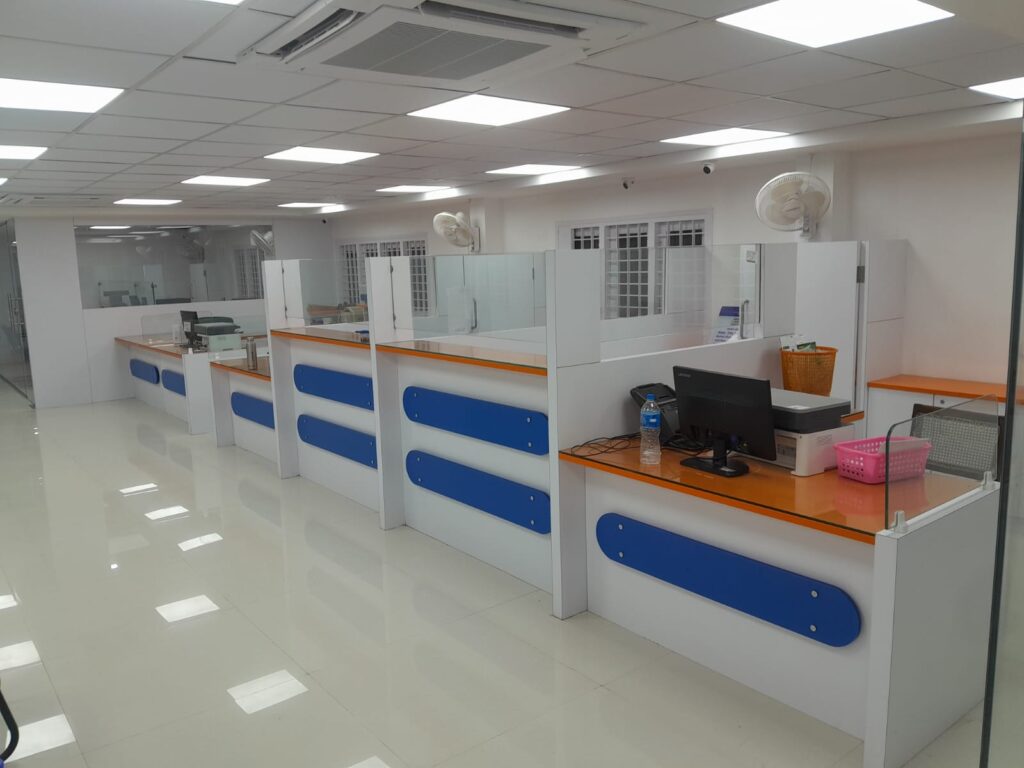
For example, teller counter installation followed defined measurement protocols to ensure ergonomic alignment. Electrical load balancing was verified before final fitting. Glass partitions were installed with visibility and surveillance logic in mind. Lighting placement was checked for glare and uniformity across branches.
This prevented the gradual drift in quality that often happens when projects are geographically dispersed.
Uniform standards create predictable outcomes.
The invisible layer: Operational engineering
What customers see in a bank is only the visible layer. The real success lies in the invisible layer.
Electrical panels were designed with load distribution clarity and future expansion provisions. Data cabling was planned to support long term technological upgrades. Strong room construction adhered strictly to compliance norms. Accessibility provisions ensured regulatory adherence and customer inclusivity.
Even small decisions carried long term impact. Counter heights were optimised for comfortable transactions. Waiting area layouts accounted for realistic peak footfall rather than idealised averages. HVAC placement ensured even cooling across transaction zones. Service access points were positioned for maintenance without disrupting operations.
These are not glamorous design choices. They are responsible ones.
Infrastructure must function quietly and reliably for years. That requires foresight during execution.
Brand presence with restraint
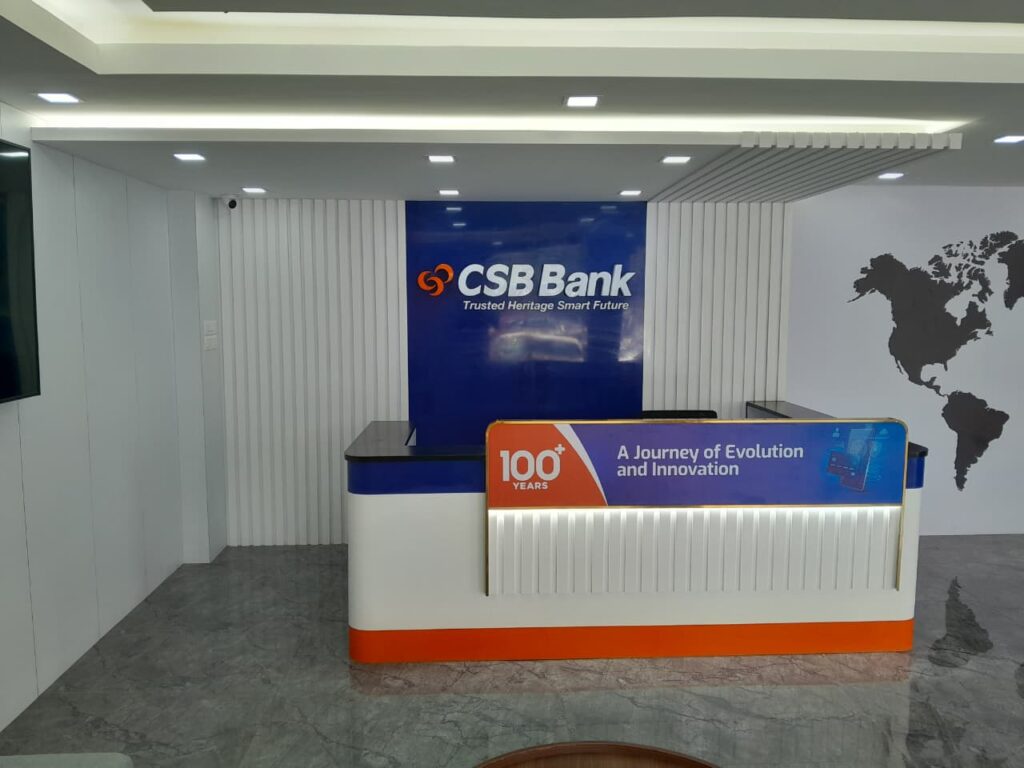
Reception areas across CSB Bank branches reflect a consistent visual language. Clean backdrop panels, structured lighting and well positioned branding elements create a controlled and professional first impression.
There is no unnecessary architectural drama. The objective is reassurance.
Customers entering a bank look for stability and clarity. A well organised reception desk, balanced lighting and defined seating communicate seriousness and reliability. The brand presence is strong but not overwhelming.
By prioritising proportion, finish quality and lighting discipline, Triver ensured that visual identity enhanced operational flow rather than competing with it.
Subtlety, when executed well, builds trust.
Adapting to regional nuances
Although standardisation was central to the rollout, regional nuances demanded thoughtful adaptation.
Coastal environments required attention to moisture control and material durability. High footfall urban centres required additional planning around circulation and queuing. Semi urban contexts required closer supervision of local trades to ensure that finish standards did not vary.
Rather than allowing local variation to dilute the design framework, Triver’s teams integrated local learning into the execution plan. Each branch retained its individuality in site context while preserving brand consistency and performance standards.
Adaptability strengthened the system instead of weakening it.
Handover as operational readiness
Project completion in banking infrastructure is not measured by physical handover. It is measured by operational readiness.
Before final handover, walkthroughs simulated daily branch conditions. Movement paths were evaluated. Counter functionality was tested. Electrical systems were verified under load. Lighting uniformity was reviewed. Glass partitions and security alignments were rechecked.
The objective was simple. On the first day of operation, the branch should function as intended without improvisation.
Execution is successful only when users do not notice it.
The broader lesson
The CSB Bank rollout across South India demonstrates an essential truth about design and build delivery.
Scalability does not come from creativity alone. It comes from structure.
In an environment where many commercial spaces aim for visual distinctiveness, banking infrastructure must aim for operational excellence. The safest branch is not the most visually striking one. The most efficient branch is not the one with dramatic finishes. It is the one where customers move smoothly, employees work comfortably, compliance standards are embedded and maintenance remains predictable.
Boring design, in banking, is intelligent design.
Infrastructure that performs
Across Mannarkad, Thrissur, Nagercoil, Sindhanur, Sivamoga and beyond, Triver delivered branches that reflect this philosophy. Each project required coordination, precision and disciplined governance. Each site demanded attention to both visible and invisible layers of execution.
The outcome is not just a set of completed interiors. It is a network of operational spaces that function reliably, reflect brand integrity and support long term performance.
In banking, trust is everything.
And trust is built not through design spectacle, but through disciplined execution.
At Triver, we build infrastructure that performs.
Because in spaces that handle financial trust, performance is the only design that truly matters.