

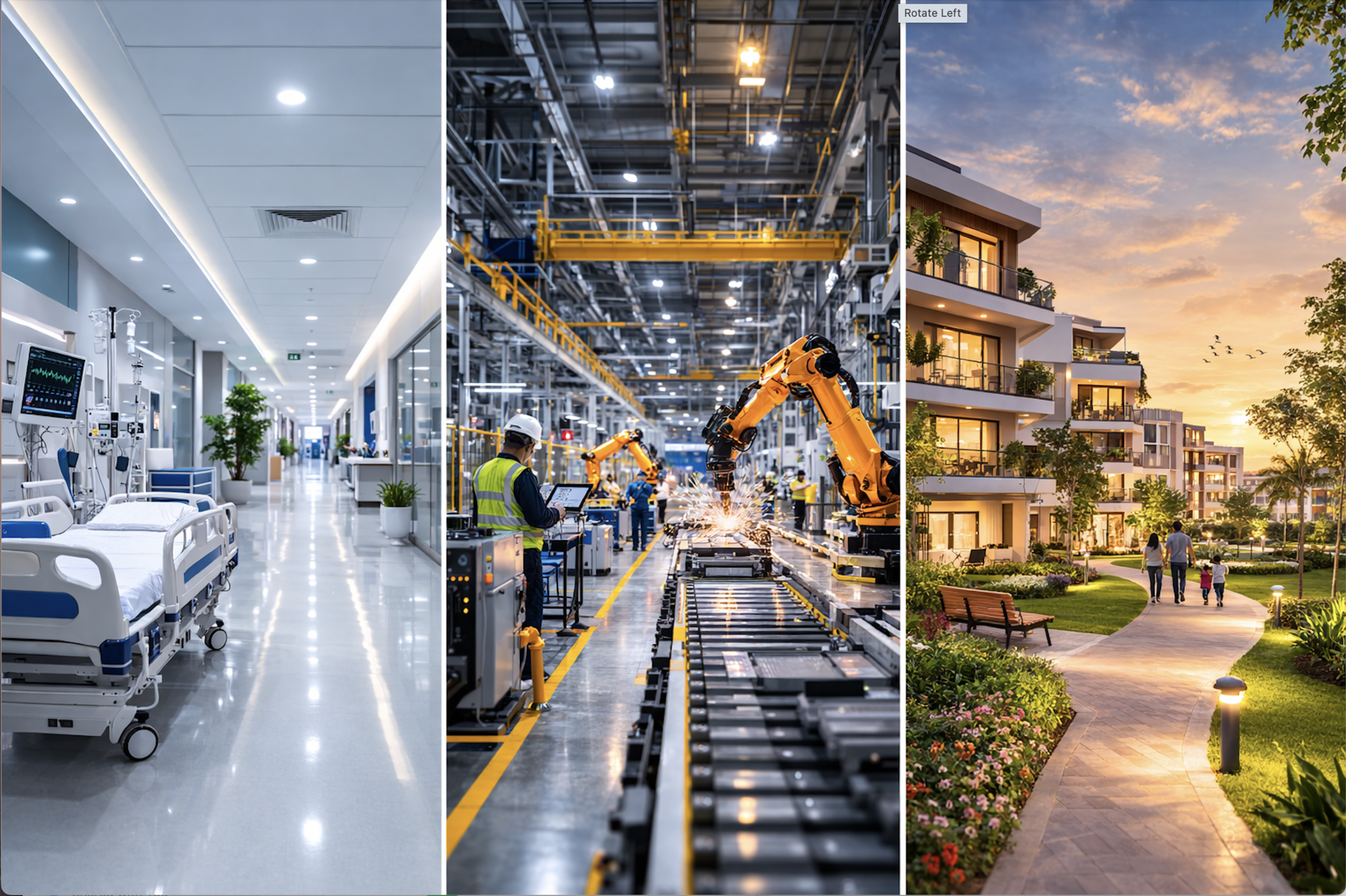
Facility management (FM) is often talked about in the context of campuses, corporate offices, and workplace environments. That focus makes sense – a large proportion of FM budgets and attention historically went into managing commercial buildings. But today’s FM landscape has moved far beyond traditional office walls. As infrastructure grows larger, more complex, and more critical to daily life, the role of FM has expanded into arenas that touch people’s experiences, safety, continuity and wellbeing in fundamental ways.
In this era, facility management is not just about keeping lights on and toilets clean. It is about ensuring safety, resilience, continuity and performance of spaces where millions of people live, work, heal, travel and learn. Integrated and strategic FM has become essential to modern infrastructure.
Let’s explore what this means, why it matters, and how organisations that embrace a broader FM mandate are reaping real operational advantages.
Market scale: A $2+ trillion opportunity
Globally, the facility management services market was valued at approximately USD 1.75 trillion in 2024 and is projected to grow to more than USD 2.33 trillion by 2033. This reflects a steady expansion at around 3.3% CAGR, with Asia Pacific emerging as one of the fastest growing regions.
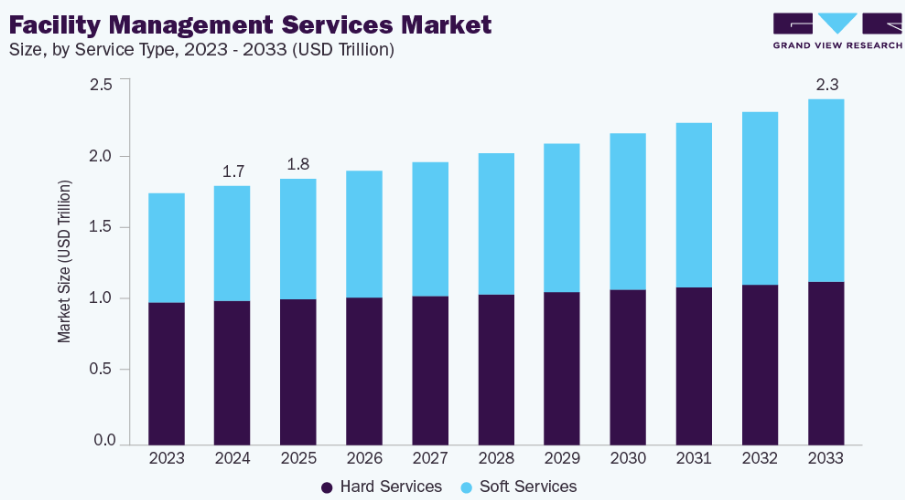
*Source – Grand View Research
Another market projection by Research Nester places the global FM industry at over USD 57.5 billion in 2025, rising to almost USD 130 billion by 2035 at a near double-digit CAGR.
In India specifically, estimates for the FM market point to strong growth too. IMARC forecast sees the market climbing from roughly USD 2.86 billion in 2025 to over USD 7 billion by 2034, at a compound annual rate of more than 10%+.
These figures alone tell a clear story: FM has moved well beyond “office services.” It is a foundational sector underpinning a wide range of built environments.
What Facility Management really encompasses
Facility management, as a discipline, is about coordinating space, people and infrastructure. Historically centred on building operations and workplace comfort, it now includes a broad spectrum of services — from hard technical systems like mechanical and electrical equipment maintenance to soft services like cleaning, security, waste management, landscaping, transport and more.
This expanded remit reflects how organisations and governments now view FM – not as a reactive maintenance function, but as a strategic driver of efficiency, safety, sustainability and experience.
Why FM beyond workplaces matters now
The post-pandemic era, rapid urbanisation, digital transformation and changing citizen expectations have all elevated the importance of FM outside traditional workplace settings.
Here are the key reasons why.
1. Critical public infrastructure needs FM expertise
Public facilities like hospitals, transport hubs, educational institutions, airports, rail stations and government complexesare high-impact environments. The stakes in these spaces are far higher than maintaining a comfortable office.
For example:
- Hospitals: In healthcare facilities, failures in HVAC, power systems, water, sanitation or waste management have direct implications for patient safety and infection control. A malfunctioning system is no longer an inconvenience – it is a risk. This requires FM to be proactive, capable of predictive maintenance, regulatory compliance and rapid turnaround. Integrated FM that manages both clinical engineering and facility systems is now a must for modern healthcare ecosystems.
- Transport & Airports: Airports like those managed by large infrastructure groups demonstrate complex FM needs. Major operators like GMR Group manage multiple airports across India. Daily operations involve coordination of security infrastructure, passenger flow systems, baggage handling, terminal maintenance, energy systems, safety protocols and passenger amenities – all under one cohesive management framework.
- In airports alone, a failure in any one system – say baggage conveyors, escalators, or HVAC – can cascade into flight delays, reputational damage, or safety hazards.
These environments demand integrated FM thinking, because fragmented outsourcing simply cannot deliver the visibility, coordination and responsiveness that critical infrastructure requires.
2. Urbanisation and smart cities will only grow FM responsibility
India is rapidly urbanising. As cities expand, infrastructure complexity increases. Governments have launched initiatives like the Smart Cities Mission and nationwide connectivity projects that emphasise technology, sustainability, and integrated urban services. These generate high demand for professional FM services across both public and private spaces.
FM now touches:
- Water and wastewater systems
- Public health infrastructure
- Road and bridge serviceability
- Smart lighting and energy management
- Urban sanitation systems
- Public safety and crowd management
This represents a significant shift: FM is no longer an internal, proprietary good. It is a public utility discipline.
3. Integrated FM delivers better outcomes than fragmented outsourcing
Modern FM needs are not just about doing more; they are about doing better in a coordinated way.
Fragmented outsourcing, where different vendors manage different services, creates gaps:
- No single accountability owner
- Data silos and poor visibility
- Conflicting service schedules
- Difficulty tracking performance metrics
- Contrast this with integrated facility management:
- One point of responsibility
- Unified data and tracking
- Faster issue resolution
- Better long-term planning
- Lower total cost of ownership
For example, in large multi-facility portfolios in South India, organisations that moved from fragmented vendor structures to integrated FM reported clearer response mechanisms, higher preventive maintenance compliance and improved occupant satisfaction. These changes reduce unplanned downtime and help align FM with organisational goals.
This reinforces a market trend noted in industry reports: integrated and outsourced FM contracts are growing faster than traditional in-house models.
4. Technology is redefining FM’s role
Technology is rapidly changing the way FM is executed.
IoT sensors, predictive analytics, AI-enabled maintenance, real-time monitoring and mobile reporting platforms are helping FM teams shift from reactive maintenance to predictive and preventive strategies. This enhances uptime, reduces costs, and improves service quality.
Yet challenges remain. Adoption in India is still uneven due to investment costs, skill gaps and resistance to change.
But the future is clear: organisations that embrace technology in FM are gaining strategic advantage.
5. FM’s role in safety, sustainability and ESG
Facility management is now a core enabler of environmental, social and governance (ESG) outcomes.
Why this matters:
- Energy usage optimisation reduces carbon emissions
- Waste management supports sustainability targets
- Safe, compliant facilities enhance occupant wellbeing
- Predictive maintenance prolongs asset life and avoids waste
FM is now part of organisational risk frameworks and sustainability reporting rather than an isolated back-office function.
To make this real, here are some practical real-world contexts where FM goes far beyond office buildings.
- Healthcare Facilities
Maintaining sterile environments, reliable life support systems, robust electrical backup, efficient sanitation, medical gas systems and infection control requires precision, discipline and strict compliance. FM in hospitals is mission critical.
- Educational Campuses
Managing residential hostels, laboratory infrastructure, power systems, water systems, sanitation, sports facilities, campus safety and student transportation is a broad FM mandate that directly impacts student experience and safety.
- Manufacturing and Industrial Parks
These facilities house mission-critical production lines. FM here is tied to preventive maintenance schedules, safety compliance, waste management, logistics support and asset uptime, any downtime directly affects output, revenue and safety.
- Residential Communities
Today’s large residential complexes are managed communities needing services like lift maintenance, water treatment, waste management, security systems, landscaping and resident support services. FM ensures quality of life, not just operational efficiency.
FM is strategic infrastructure stewardship
Facility management beyond workplaces is not a niche. It is a fundamental shift in how societies and organisations maintain, operate and sustain their built environment.
From hospitals to transport hubs, educational campuses to residential communities, airport terminals to industrial parks – FM is the discipline that ensures continuity, safety, performance, and resilience.
The market growth projections, increasing complexity of assets, urbanisation trends and technology adoption signal one thing clearly: facility management is no longer a cost centre. It is a strategic function that underpins organisational success and societal resilience.
As the industry evolves, so too must the way we think about it – not as cleaning floors or fixing equipment, but as stewarding the environments where life happens.