

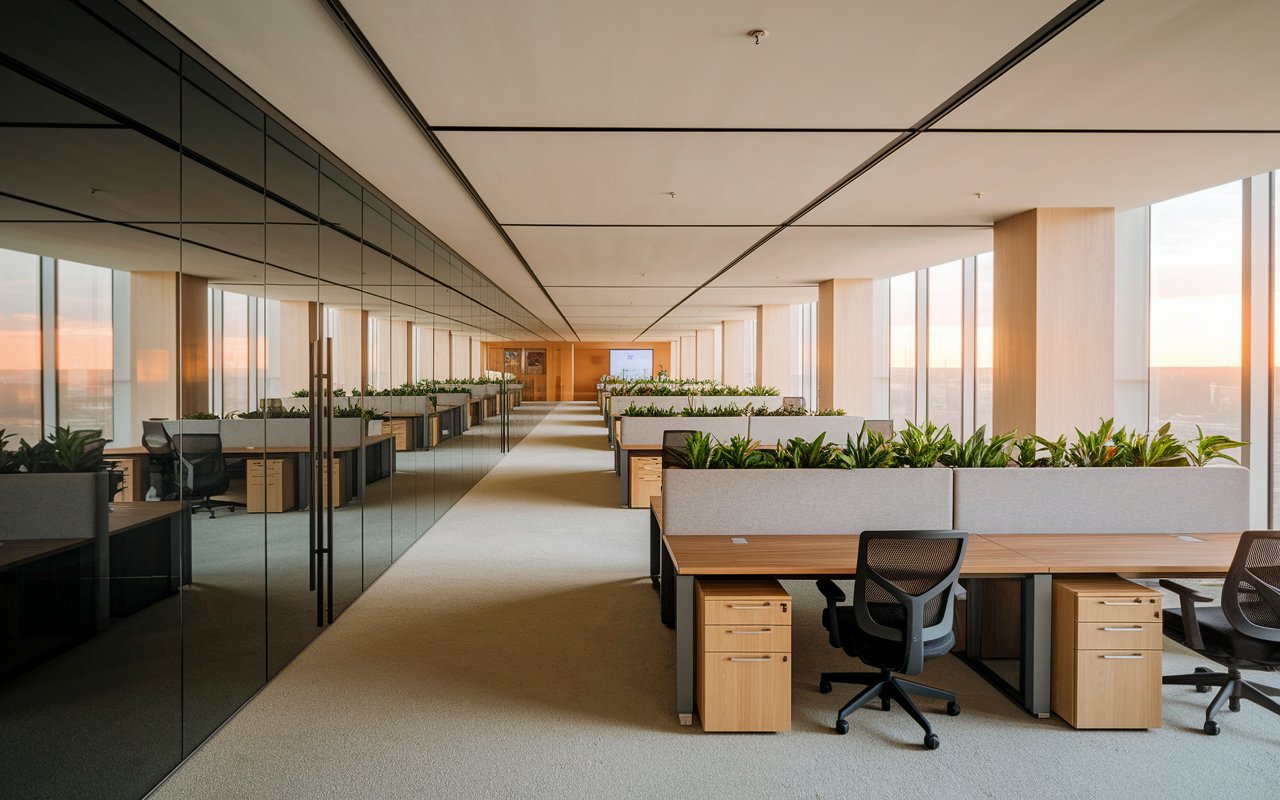
Across India’s key commercial hubs such as Bengaluru, Mumbai, Delhi NCR, and Kochi, office costs have steadily moved up the leadership agenda. Rising commercial rentals, increasing fit out costs, and higher operating expenses mean that office space is no longer a passive infrastructure decision. For CEOs and CFOs, it is now a strategic financial consideration that directly affects profitability and long-term scalability.
Despite this, many organizations still treat office interiors as a one-time aesthetic exercise or a facilities driven project. In reality, workplace design has a direct impact on capital expenditure, operational efficiency, and the total cost of ownership over the lease term. When planned correctly, office design becomes a practical tool for cost control, not an added expense.
At Triver, we see this shift most clearly in cities like Bengaluru and Mumbai, where businesses are under pressure to extract maximum value from every square foot while maintaining delivery timelines and compliance.
Understanding where office costs actually sit in India
For most Indian companies, office related costs extend far beyond rent and interiors. The real spend is distributed across initial fit out, recurring operational expenses, and hidden future costs that often surface after occupancy.
Interior fit out and turnkey execution form a significant upfront investment, especially in Grade A commercial buildings across Mumbai and Delhi NCR. This is followed by ongoing expenses such as power, air conditioning, maintenance, and services. What often goes unnoticed are the costs of rework, frequent layout changes, delayed approvals, and productivity loss caused by inefficient space planning.
Smarter workplace design addresses all this together rather than focusing only on reducing the initial fit out number.
Right sizing office space for actual usage patterns
One of the most common reasons office costs escalate in Indian cities is over allocation of space. Many offices in Bengaluru, Kochi, and Delhi NCR are still designed for full occupancy, even though hybrid work models have significantly reduced daily utilization.
When office space is planned based on real usage data rather than assumptions, organizations can reduce their leased area without affecting employee experience. Optimized seat ratios, flexible work settings, and shared collaboration zones allow companies to operate efficiently with a smaller footprint. Over the duration of a long-term lease, even a modest reduction in area can result in substantial savings, particularly in high rental markets like Mumbai and Bengaluru.
Reducing even a small percentage of leased areas can translate into substantial savings over a long-term lease in cities like Bengaluru or Mumbai. Smarter space planning ensures that every square foot delivers value.
Why integrated design and build controls cost better
A key reason commercial interior projects in India exceed budgets is the gap between design intent and on-site execution. When design and construction are handled separately, changes during execution are common, leading to delays and cost overruns.
An integrated design and build approach solves this problem by placing accountability with a single partner. Designs are developed with a clear understanding of execution constraints, local regulations, and cost implications from the outset. This leads to better cost predictability, fewer changes during construction, and tighter control over timelines.
For offices in cities such as Delhi NCR and Bengaluru, where project delays can significantly impact business continuity, this approach offers measurable financial benefits.
Space planning that improves efficiency without compromise
Cost efficient office design is not about reducing comfort or density at the expense of people. It is about making space work harder.
In Indian offices, this often means right sizing meeting rooms, replacing underutilized cabins with flexible enclosed spaces, and designing collaboration areas that support multiple uses. Thoughtful circulation planning reduces wasted space while improving movement and accessibility.
The result is an office that supports productivity, adapts easily to change, and requires less frequent reconfiguration over time.
Smarter material choices that lower long-term costs
Material selection plays a major role in determining both upfront and long-term costs of office interiors in India. Imported finishes and excessive customization often inflate budgets without delivering proportional value.
Using durable, locally available materials that are suited to Indian climatic and usage conditions helps control costs over the life of the office. Standardizing finishes across locations in Mumbai, Bengaluru, Kochi, and Delhi NCR further improves procurement efficiency and reduces maintenance expenses.
The focus shifts from lowest upfront cost to long term durability and ease of maintenance.
Energy efficient design as a cost control strategy
Energy consumption is one of the largest ongoing expenses for commercial offices across India. Design decisions made during the planning stage have a lasting impact on how much an office spends on power and air conditioning.
Offices designed to maximize natural light, use efficient lighting systems, and apply intelligent HVAC zoning consistently show lower operating costs. While these measures may marginally increase initial investment, they deliver strong returns over the lease term, particularly in energy intensive markets like Mumbai and Delhi NCR.
For CFOs evaluating total cost of ownership, energy efficiency is a critical design consideration.
Compliance driven design prevents delays and rework
Local authority approvals and fire safety compliance remain a major challenge for office projects in India. Each city has its own regulations, and non-compliance often leads to last-minute changes, delays, and additional costs.
Designing with compliance in mind from the start ensures smoother approval and avoids expensive rework during execution. This is especially important in cities like Bengaluru and Delhi NCR, where approval timelines directly affect project delivery schedules.
A compliance led approach protects both budgets and business timelines.
Designing offices that support growth and change
Indian businesses evolve quickly. Expansion, consolidation, and operational shifts are common, particularly in fast growing markets such as Bengaluru and Kochi.
Office design that incorporates flexibility allows organizations to adapt without incurring significant additional capital expenditure. Modular furniture, demountable partitions, and scalable infrastructure enable offices to change with minimal disruption.
Flexibility is one of the most effective yet underutilized ways to control long term office costs.
Making office design a Leadership decision
The most cost-efficient office projects are those where CEOs and CFO are involved early in the decision-making process. When leadership evaluates office design through the lens of total cost of ownership, execution risk, and long-term flexibility, outcomes improve significantly.
Office design is no longer just about how space looks. It is about how efficiently it operates, how easily it adapts, and how well it supports business objectives over time.
Conclusion
For Indian organizations operating in Bengaluru, Mumbai, Delhi NCR, and Kochi, smarter workplace design is a practical and measurable way to reduce office costs while improving performance.
When office interiors are planned with clarity, built with discipline, and delivered with accountability, they stop being a recurring cost burden and start becoming a strategic asset.
At Triver, we design and build workspaces that balance cost efficiency, execution certainty, and long-term value. Because in today’s business environment, smarter spaces lead to stronger outcomes.