

In many industries, unplanned downtime is a silent tax on performance. Data from industrial operations show that facilities lose, on average, 30 hours of productive time per month due to downtime i.e. 360 hours a year. Even a few unplanned hours can cascade into significant revenue losses, lower throughput, and delayed service delivery.
Turning this into the context of facilities renovation: a retail outlet forced to close for a week may lose 8-12% of monthly revenue simply from lost footfall. A hospital or banking branch, where services are essential, suffers reputational and regulatory costs as well. The stakes are especially high where continuity is part of the service promise.
Trivers’ example: Banking branch renovation in Coimbatore
One of the most illustrative cases Triver has handled was a major renovation of a banking branch in Coimbatore. This branch was due for a complete refresh – civil works, electrical upgrades, interiors and technology enhancements – yet could not shut its doors. Every day of closure meant account holders unable to transact, ATMs offline, lockers inaccessible, and customer confidence eroded.
Rather than attempt a conventional renovation, the project team redesigned every phase:
- Work was done primarily after banking hours, with night shifts and early morning windows.
- Client facing areas were sectioned with temporary barriers to separate live operations from construction zones.
- Temporary counters and signage-maintained customer service continuity.
- Equipment noise control protocols and dust containment systems ensured a safe, comfortable environment within the operational zones.
The result? Over the renovation period, the branch maintained more than 80 percent functional capacity daily. Business as usual continued, customers experienced minimal inconvenience, and the renovation was completed on schedule. This was achieved not by cutting corners, but by rigorous planning, sequencing and stakeholder coordination.
Case insight: Retail & Healthcare
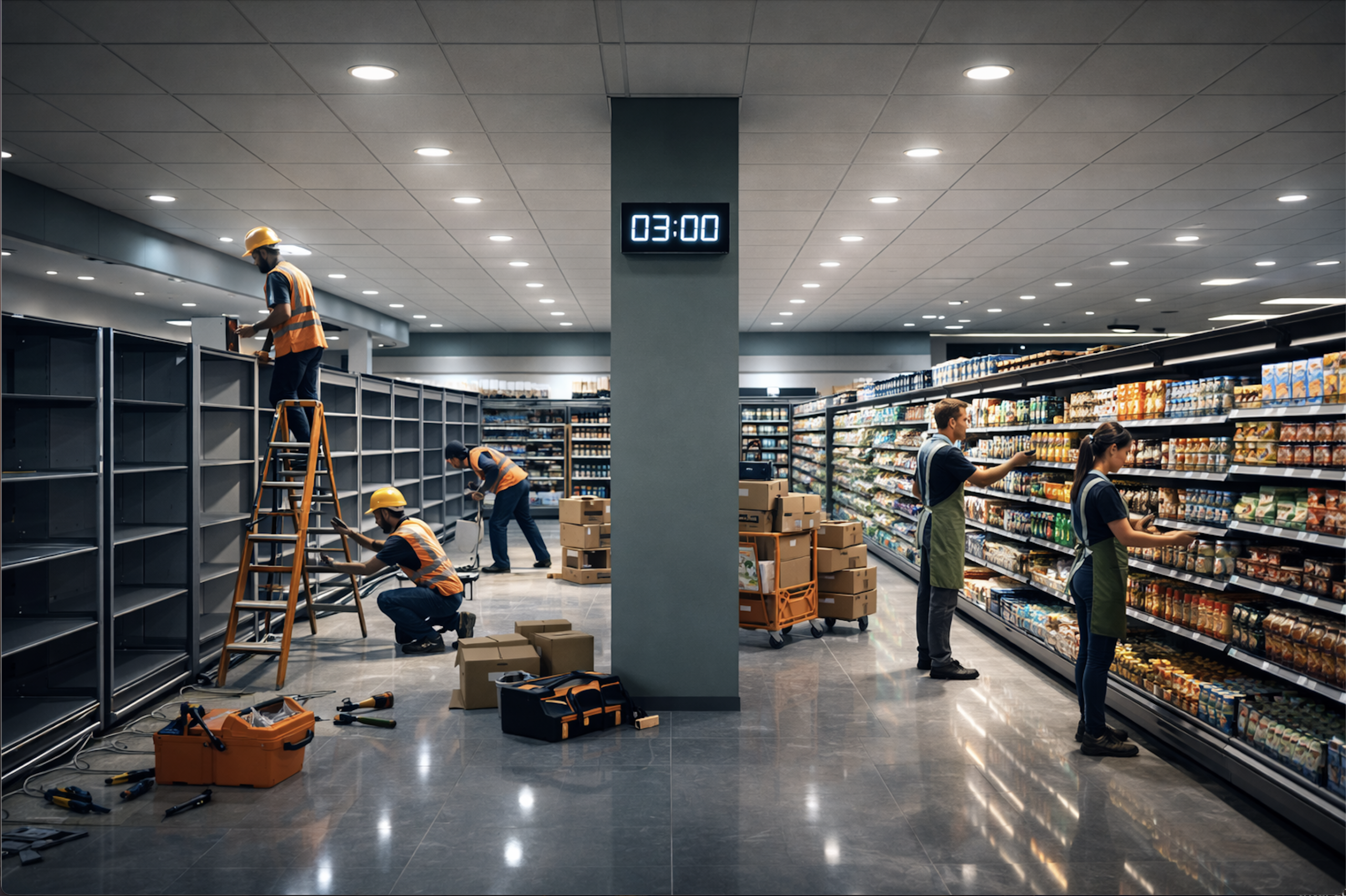
In retail chains, phased renovations with modular planning are increasingly common. A grocery chain executed a store upgrade by rerouting customer flow and isolating construction zones, keeping checkouts and essential aisles open. Phased shelving and nightly resets ensured customers were unaware of significant work happening around them.
Hospitals present an even tougher challenge. Patient safety and uninterrupted clinical services require that renovation teams work around strict infection control, emergency access and continuous utility supplies. Successful hospital renovations often rely on temporary HVAC systems, isolated zones for sterile areas, and meticulously planned work sequences that avoid disruption to core services.
These examples share a common thread: renovation leadership that treats operation continuity as a non-negotiable project requirement.
The hidden cost of downtime
It is not just revenue that is jeopardised when operations stop unexpectedly. According to Verdantis, in an industrial settings, equipment failure and poor maintenance planning, which are effectively forms of operational downtime, can cost upwards of $125,000 per hour. Organisations with poor maintenance routines see reactive failures 4 to 5 times more costly than proactive ones. Planned maintenance programs, on the other hand, can trim these costs by 12-18% and reduce breakdowns by as much as 70-75%.
While these figures are drawn from manufacturing, the principle translates directly to renovation: unplanned closures and disruptions carry far higher financial and reputational burdens than the incremental costs of careful sequencing and stakeholder management.
Principles for renovation without downtime
1. Plan with the end in mind
Renovation is not just about design, it is about sequencing. Start with a clear understanding of business rhythms: peak hours, service dependencies, critical paths and customer impact points. This informs which tasks can be scheduled off-peak, which require temporary alternatives, and where phased barricading is essential.
A comprehensive renovation plan accounts for every ripple effect. For example, installing new flooring can’t be done during business hours if it blocks access to revenue generating spaces. Instead, it might be completed in nightly micro-phases that retain aisle accessibility.
2. Leverage temporary utilities and support systems
To keep essential services running, many projects use temporary utility feeds, provisional HVAC, backup power and mobile customer service units. In healthcare, this may mean portable imaging stations. In banking, temporary ATMs and customer service counters ensure continuity.
The same approach is seen in IT migrations – cloud calling systems have been migrated for some organisations with zero downtime across thousands of users by phased rollouts that maintain existing connections until new systems are live.
3. Use predictive maintenance and data analytics
In MRO (Maintenance, Repair and Operations), robust data and predictive analytics enable maintenance teams to anticipate issues and schedule work before failures happen. Techniques like predictive maintenance migrate unplanned stops into planned, shorter interruptions that are easier to accommodate.
In renovation planning, the same predictive mindset helps identify where infrastructure constraints might cause major disruptions and address them early in design.
4. Stakeholder alignment – early and often
Internal teams, operations staff, clients, users and frontline workers all have insights into where disruptions hurt most. Engaging them early sharpens the renovation strategy. For example, retail store staff can highlight peak traffic windows; hospital administrators can identify critical care corridors that can never be blocked.
5. Use phased engineering and modular design
Breaking a project into self-contained modules, and completing them one at a time, allows the core business to operate around the work.
This is common in airport renovations where one concourse or gate is upgraded while others absorb passenger flow. Phasing ensures passenger movement and airline operations remain as close to normal as possible.
The ROI of respecting operations
When renovation teams internalise the importance of operational continuity, the ROI goes beyond bricks and mortar:
- No revenue drop from closure
- No customer frustration
- Stronger operational resilience
- Faster adoption of improvements
- Better stakeholder trust
The alternative often looks like this: extended closures, rushed work to make up for lost time, quality issues, and higher claims. The impact is not just financial – brand and service loyalty can erode quickly when customers are inconvenienced.
Building a culture that respects continuity
Ultimately, delivering renovation without operational downtime requires more than techniques – it requires a mindset shift. Projects are not interruptions in business flow but enhancements that must be delivered while respecting current commitments.
At Triver, this mindset is embedded in our approach to every sector, whether its co-working spaces, schools, hospitals or banking branches. Renovation executed with respect for ongoing operations not only minimizes risk but amplifies value.
Renovation without operational downtime is not easy. It demands planning, coordination, sequencing and discipline. But in a world where customers and stakeholders expect continuity, this is not an optional luxury, this is strategic infrastructure leadership.